
Studies on the General Effects of Using Wireless and Mobile Technology (and Screens)
In this page, we present studies on the general effects of using wireless and mobile technology, such as psychological, mental and behavioral effects, reduced performance and more.
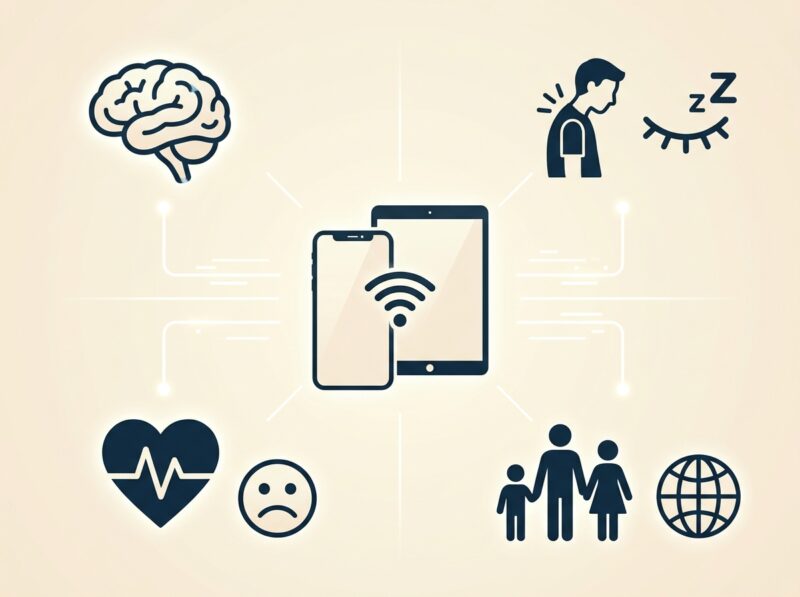
Beyond the effects of exposure to non-ionizing radiation, the use of mobile phones and of electronic and wireless communication and entertainment devices carries additional effects and dangers: addiction, vision damage, exposure to blue light, worsening attention and concentration disorders, weakened interpersonal communication skills, and more. These effects can already be seen in most of the population. Research in this field is already close to a consensus that there is damage and harm, and that steps must be taken immediately to prevent it.
Because of the lack of awareness of the harm caused by radio frequency radiation, and other types of non-ionizing radiation emitted by many screens such as smartphones, wireless laptops and tablets, studies usually ignore radiation as a possible cause of the effects and changes they observe.
We present a number of studies in this field. Again, this is only the tip of the iceberg.
Studies on the Effects of Using Wireless and Mobile Technology
- Swedish team, 2012, Sara Thomée, Annika Härenstam and Mats Hagberg – Use of Devices for Consuming Content and Information Causes Depression and Behavioral Disorders
The article presents and supports the theory that heavy use of advanced devices for consuming content and information (mobile phones, smartphones, computers etc. = ICT) harms the mental health of young adults:
- Intensive, frequent mobile phone use leads to sleep disorders in men and depression in women and men.
- Heavy computer use (continuous use for hours without a break) contributes to sleep disorders in men and women, and to symptoms of depression in women.
Full article:
https://gupea.ub.gu.se/bitstream/2077/28245/1/gupea_2077_28245_1.pdf
Abstract:
https://www.ncbi.nlm.nih.gov/pmc/articles/PMC3528646/
DOI: 10.1186/1471-244X-12-176
(About the study in Hebrew:
http://www.tapuz.co.il/blog/net/ViewEntry.aspx?EntryId=2282408)
– Mobile phones, smartphones, computers etc. harm the mental health of young people
- Israeli team, Ben-Gurion University, 2009 – Mobile Phone Radiation Lengthens People’s Reaction Time
An Israeli study conducted at Ben-Gurion University, together with the Soreq Nuclear Research Center, found that exposure to mobile phone radiation causes longer reaction times in users. Eye-hand coordination was tested on 48 users. The findings showed that right-handed people exposed on the left side of the head had much longer reaction times than when exposed on the right side of the head, or under sham exposure (no radiation exposure at all).
Abstract:
https://www.ncbi.nlm.nih.gov/pubmed/19194860
DOI: 10.1002/bem.20458
– Exposure to radio frequency radiation from mobile phones - USA and Denmark, 2008 – Mobile Phone Use by Pregnant Mothers and by Children up to Age Seven Causes Behavioral Problems
The study was based on a questionnaire completed by 13,159 mothers of 7-year-old children, who used a mobile phone during pregnancy and/or whose children use a mobile phone today. The mothers were asked many questions about the way the phone was used and about their children’s behavior.
The findings showed that behavioral problems were 1.8 times more common in children whose mothers used a mobile phone during pregnancy and/or who used a mobile phone themselves up to age seven, compared with children whose mothers did not use a mobile phone during pregnancy and/or who did not use one themselves up to age seven.
According to the researchers, since the radiation reaching the fetus during pregnancy is very small, it was hypothesized that the cause may be a biochemical change in the mother caused by mobile phone use during pregnancy. In my opinion, it may very well also be an indication that even very low levels of radiation have an effect.
Abstract:
https://www.ncbi.nlm.nih.gov/pubmed/18467962
DOI: 10.1097/EDE.0b013e318175dd47
– Very low levels of radiation are a possible cause of behavioral problems in children - Taiwan, 2014 – More Suicidality Among Heavy Mobile Phone Users Than in the General Population
Of more than 5,000 subjects, over 10.54% were defined as heavy mobile phone users. Of these:
- More than 23% reported suicidal ideation (compared with 11.76% among those who were not heavy users).
- More than 13.70% had attempted suicide (compared with 5.45%).
https://www.ncbi.nlm.nih.gov/pubmed/24262117
PMID: 24262117, DOI: 10.1016/j.comppsych.2013.09.006
– More suicidality among heavy mobile phone users
- Israeli team, Ben-Gurion University, 2017 – More Behavioral Problems and Lower Performance Among Mobile Phone Users
An Israeli study compared task performance and social functioning between 36 people who do not use a mobile phone and 16 heavy users. Afterwards, some of the non-users were given smartphones for three months, and the tests were then repeated.
The results showed reduced social skills, more hyperactivity and impulsivity, and poorer and less accurate task performance among heavy mobile phone users. The second part of the study showed that the decline in functioning and performance is linked to mobile phone use.
Abstract:
https://journals.plos.org/plosone/article?id=10.1371/journal.pone.0180094
https://www.ncbi.nlm.nih.gov/pubmed/28678870
DOI: 10.1371/journal.pone.0180094
– Mobile phone use harms behavior and performance - University of Haifa, 2017 – Blue Light from Screens Harms Sleep Quality
The blue light emitted by the screens we watch is what harms the duration and, above all, the quality of our sleep. Watching screens that emitted red light did not cause this harm, and sleep was similar to normal sleep.
https://www.haifa.ac.il/index.php/he/2012-12-16-11-30-04/2015-01-25-11-22-48/2552-2017-08-22-08-32-40.html
PMID: 28548897, DOI: 10.1080/07420528.2017.1324878
– Blue light from screens harms sleep quality - The Mere Presence of a Mobile Phone Near the Subjects Reduced Their Performance
https://www.journals.uchicago.edu/doi/10.1086/691462
DOI: 10.1086/691462
– Mobile phones harm performance - Norwegian Institute of Public Health, 2024 – A Total Ban on Bringing or Using Mobile Phones in Schools Improved Health and Performance Measures
According to a 73-page Norwegian study that reviewed data from 2010 to 2018, schools where mobile phones were completely banned (students were not allowed to bring them to school, or had to hand in their devices at the start of the school day) saw improvements in health, behavior and achievement:
- 60% fewer psychological illnesses and symptoms among girls.
- Higher GPA (matriculation) grades and external comparative math test scores among girls, including a higher rate of continuing to high school and academic studies.
- Fewer problems of harassment and bullying among students.
- The improvements were especially strong among girls, particularly from low socioeconomic backgrounds.
According to psychologist Tom Kersting, the phone is a constant source of distraction, even when it is in a pocket on vibrate.
Abrahamsson, Sara, Smartphone Bans, Student Outcomes and Mental Health (February 22, 2024). NHH Dept. of Economics Discussion Paper No. 01.
https://papers.ssrn.com/sol3/papers.cfm?abstract_id=4735240
DOI: 10.2139/ssrn.4735240
(About the study, in English:
https://www.theepochtimes.com/health/this-is-what-happened-after-several-schools-banned-cellphones-5644536)
– Banning mobile phones, or requiring students to hand them in, improved the mental health and performance of female and male students
- American team – Keeping Mobile Phones Away from Students Improved Their Sense of Understanding and Engagement, and Reduced Stress
72 students (post-secondary, undergraduate) were not restricted in their mobile phone use during lessons. 36 were instructed to place their mobile phones on a table near the front of the classroom at the start of each lesson, and were not allowed to access, operate or use the devices during the lesson. At the end of the courses, the subjects completed questionnaires on their sense of understanding of the course material, anxiety and engagement in class.
The data showed that those whose mobile phone use was restricted felt less stress and more engagement, and had a higher sense of understanding.
https://pmc.ncbi.nlm.nih.gov/articles/PMC9676861/
PMCID: PMC9676861, PMID: 36440453
(Graph summarizing the findings:
https://pmc.ncbi.nlm.nih.gov/articles/PMC9676861/figure/Fig1/)
– Keeping mobile phones away from students improved their sense of understanding and engagement, and reduced stress - Chinese team, 2020 – The Effect of Restricting Phone Use Before Sleep
A study published in 2020 found that restricting phone use before sleep improved sleep quality, reduced arousal before sleep, and improved mood and working memory.
https://pmc.ncbi.nlm.nih.gov/articles/PMC7010281/
PMCID: PMC7010281, PMID: 32040492
– Not radiation directly, but mobile phone use before sleep. - Saudi team, 2025 – Phone Use After Lights Out and Sleep Quality
A 2025 study found that phone use after lights out, especially for messaging and calls, is linked to various sleep disorders. The study examined sleep quality, headaches, fatigue and attention disorders in teenagers aged 15-18.
- The most significant effects were a range of sleep disorders.
- In addition, high school students suffering from sleep disorders generally suffer more from headaches, lack of sleep, lack of energy, difficulty concentrating and fatigue.
https://www.sciencedirect.com/science/article/pii/S2405844025010357
DOI: 10.1016/j.heliyon.2025.e42655
– Mobile phone use after lights out led to a range of sleep disorders among high school students.
- Australian team, 2024 – Double-Blind Controlled Study on RF Radiation Exposure
A 2024 study examined the effect of exposure to 2.45 GHz RF radiation (as in a baby monitor) on the sleep quality of 12 healthy adults over 4 weeks:
- Week 1: no baby monitor in the room and no exposure.
- Week 2: a device in the room; for some subjects it transmitted, for others it did not.
- Week 3: no device for anyone.
- Week 4: those who had been exposed in week 2 now slept with a non-transmitting device, and those who had not been exposed in week 2 now slept with a transmitting device.
The findings showed a significant decline in sleep quality during exposure, with changes in EEG measures during the different sleep stages in the subjects exposed to the radiation.
https://www.frontiersin.org/journals/public-health/articles/10.3389/fpubh.2024.1481537/full
DOI: 10.3389/fpubh.2024.1481537
Further reading:
- A summary of studies on mobile phones, attention disorders and changes in the brain, on the “Zavit” website:
http://www.zavit.org.il/%D7%94%D7%98%D7%9C%D7%A4%D7%95%D7%9F-%D7%94%D7%97%D7%9B%D7%9D-%D7%9E%D7%A9%D7%A0%D7%94-%D7%90%D7%95%D7%AA%D7%A0%D7%95/ - A summary of problems caused by screens, on the “Look Me in the Eyes” website:
https://intomyeyes.home.blog/problems/
Studies on this page:
- Swedish team, 2012 – Use of devices for consuming content and information causes depression and behavioral disorders – DOI: 10.1186/1471-244X-12-176
- Israeli team, 2009 – Mobile phone radiation lengthens people’s reaction time – DOI: 10.1002/bem.20458
https://www.ncbi.nlm.nih.gov/pubmed/19194860 - USA + Denmark, 2008 – Mobile phone use by pregnant mothers and by children up to age seven causes behavioral problems – DOI: 10.1097/EDE.0b013e318175dd47
- Taiwan, 2014 – More suicidality among heavy mobile phone users than in the general population – PMID: 24262117, DOI: 10.1016/j.comppsych.2013.09.006
- Israeli team, 2017 – More behavioral problems and lower performance among mobile phone users – DOI: 10.1371/journal.pone.0180094
- Israeli team – Blue light from screens harms sleep quality – PMID: 28548897, DOI: 10.1080/07420528.2017.1324878
- The mere presence of a mobile phone near the subjects reduced their performance – DOI: 10.1086/691462
- Norway, 2024 – A total ban on bringing or using mobile phones in schools improved health and performance measures – DOI: 10.2139/ssrn.4735240
- USA – Keeping mobile phones away from students improved their sense of understanding and engagement, and reduced stress – PMCID: PMC9676861, PMID: 36440453
- China, 2020 – The effect of restricting phone use before sleep – PMCID: PMC7010281, PMID: 32040492
- Saudi Arabia, 2025 – Phone use after lights out and sleep quality – DOI: 10.1016/j.heliyon.2025.e42655
- Australia, 2024 – Double-blind controlled study on RF radiation exposure – DOI: 10.3389/fpubh.2024.1481537