
Preview “ALL OK” EMF/EMR studies
On this page, we present and explain “reassuring” reports and studies on non-ionizing radiation. These studies and reports are usually cited by industry and by those who deny the harm. We will explain the reports, explain what was tested and how, and expose problems in the processes of planning, definition, data collection, and drawing conclusions.
Why Some Studies Find No Risk or Effect from Non-Ionizing Radiation
- Studies that did not examine risk or a link to an effect or disease at all, but tested a technology or something else, and saw no problem along the way.
- Studies that used only a carrier wave (one component of the electronic signal, clean and without information): not pulsed, without pulses and without digital information.
- Early cancer studies in which the latency period was too short (up to 5 years is considered very short; studies usually look at 15 years, and the latency period of cancer can be as long as 20–40 years).
- Studies in which the user definitions are not relevant (for example, defining a “regular user” as someone who uses a mobile phone for 5 minutes a month, or a “heavy user” as someone who uses a mobile phone for about 27 minutes a day, as in Interphone).
- Articles that group other studies together. Those that found effects are summarized as “inconclusive results”, while those that found no effects (including those that did not examine effects at all) are summarized as “most studies”.
- Studies in which a small part of the results (because of reasons 2, 3 and 4) shows a risk and most of the results do not, and which are summarized as “overall” no risk.
- Studies in which the control group was not free of exposure (for example, the Danish study).
- Industry-influenced studies.
Review Articles and Reports
Over the years, several reports have been published by national and international committees and bodies that supposedly reviewed all the scientific evidence (usually they did not) and determined that there is no basis for considering non-ionizing radiation dangerous. Unlike reports or studies that show the risk, these reassuring reports enjoy a well-oiled public relations machine and are published in the leading press, probably in order to maximize their reassuring effect. A close look at these studies and reports finds failures in collecting the scientific evidence, in the funding of the bodies, in conflicts of interest among the team members and in the conduct of the research itself (where it is a study). And of course, the presentation and summary of the data are partial and highly biased.
A Partial list of studies that give the “ALL OK” on EMR/EMF, mainly RF and cellphone radiation.
- British team funded by industry and the Department of Industry, 2014 – New British MTHR Report – Mobile Phones Are Not Dangerous (Industry funding; most of the studies reviewed are unrelated to the cancers suspected of being caused by mobile phones)
This summary by the MTHR body attempts to establish that there is no risk in using mobile phones. Publishing the report was the final act of the body, which is funded partly by industry and partly by the British Department of Industry. The report summarizes 11 years of work involving 31 research projects, summarized in 60 articles in the scientific press. All the studies were completed and published except one.
Beyond the fact that the body is partly funded by the British Department of Industry (and indirectly by industry), the report reviews studies most of which are not relevant to the types of cancer that mobile phone use is suspected of promoting or causing.
With the publication of the report, the body’s activity comes to an end. The researchers recommend not continuing to research the field (how convenient). The report has received much criticism from scientists and researchers in the field.
Report summary:
http://http://sciblogs.co.nz/griffins-gadgets/files/2014/02/MTHR-report-2012-Embargoed.pdf
(Critique of the report in Hebrew:
http://www.tapuz.co.il/blog/net/ViewEntry.aspx?EntryId=2866854
Critique of the report in English:
http://www.emfacts.com/2014/02/here-we-go-again-new-mthr-report-claims-no-health-effects-from-cell-phones-etc/
http://www.powerwatch.org.uk/news/20140214-mthr-2012-report-misleading-spin-part1.asp
https://lennarthardellenglish.wordpress.com/2014/02/13/mthr-2012/)
– Mobile phones - Danish team – The New Danish Study Concluding “Mobile Phones Are Not Dangerous” Is Fundamentally Flawed
This study should be taught in schools as an example of a whitewash. The study is updated every 5 years, and each time it is published again as one that found no risk in mobile phone use. The study is so flawed that IARC and courts around the world have rejected it as evidence. The main problem with the study is that the researchers placed about 200,000 business users, plus about 30,000 users who had more than one mobile phone (and probably talked a lot), in the control group (out of a total of 700,000 users). If mobile phone use does cause cancer, this error could increase the number of cases in the control group.
The study:
http://www.bmj.com/content/343/bmj.d6387.full
(Critique of the study in Hebrew:
http://www.tapuz.co.il/blog/net/ViewEntry.aspx?EntryId=2164880
Critique of the study in English:
http://microwavenews.com/DanishCohort.html
http://www.emfacts.com/2011/10/scientists-and-campaigners-condemn-new-mobile-phone-study-as-misleading-and-irresponsible/
http://www.powerwatch.org.uk/news/20111021-danish-mobile-phone-study.asp)
– Mobile phones - British team – The British Million Women Study – Mobile Phones Don’t Cause Cancer (Overall)
A new British study found a link between mobile phone use and auditory nerve tumors, but the finding was omitted from the conclusions. The study found a 2.46-fold increase in risk among women who used mobile phones heavily compared with women who did not use them. On the other hand, no excess risk was found for brain cancers and other tumors. The study’s publication omitted the information about the type of cancer in which an increased risk was seen, and emphasized the types of cancer in which no increase was found.
The study:
http://www.ncbi.nlm.nih.gov/pubmed/23657200
(Critique of the study in English:
http://microwavenews.com/uk-study-points-acoustic-neuroma
Critique of the study in Hebrew:
http://www.tapuz.co.il/blog/net/ViewEntry.aspx?EntryId=2554313
Critique of a follow-up study:
https://www.norad4u.co.il/2022/04/26/6652/)
– Mobile phones and auditory nerve tumors - British team – Huge British Study – No Link Between Mobile Phone Calls and Cancer – Really?
The study’s publication claimed that no increase in head cancers was seen: “The increased use of mobile phones between 1985 and 2003 has not led to a noticeable change in the incidence of brain cancer in England between 1998 and 2007”. In contrast, the lead researcher explained that an increase was seen, but in his opinion it is not significant: “a small increased rate of brain cancers in the temporal lobe corresponding to the time period when mobile phone use rose from zero to 65 percent of households”. According to the researchers, the increase in temporal lobe cancer represents one additional case per 100,000 people, and therefore no precautionary measures are needed.
Study abstract:
http://www.ncbi.nlm.nih.gov/pubmed/21280060
(Critique of the study in Hebrew:
http://www.tapuz.co.il/blog/net/ViewEntry.aspx?EntryId=1906458)
– Mobile phones and head cancers - British team – Another Misleading Study – Mobile Phones Don’t Cause Cancer in Children (After 4 Years) – CEFALO
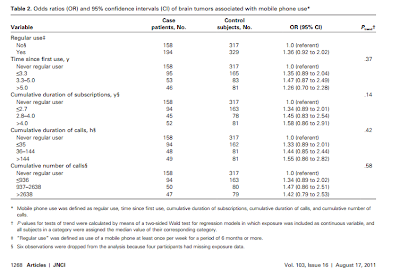
The latency period of cancer ranges from 10 to 40 years, so is it relevant to examine 4 years of exposure? The researchers thought so and published this study. The study examined about 1,000 mobile phone users. The results showed that every usage group had a higher risk of cancer compared with the control group (Table 2). In the study’s conclusions, the researchers stated that no dose-response relationship was seen, and that this contradicts the hypothesis of a link between mobile phone use and cancer, even though the study’s results clearly show such a link. The study’s publications emphasized that no dose-response relationship was seen (this was also emphasized in the study’s own publication), while the fact that an excess risk was seen in all user groups was completely played down.
Study abstract:
http://jnci.oxfordjournals.org/content/early/2011/07/27/jnci.djr244.abstract
(Full study:
https://academic.oup.com/jnci/article/103/16/1264/898567/Mobile-Phone-Use-and-Brain-Tumors-in-Children-and
Critique of the study in Hebrew:
http://www.tapuz.co.il/blog/net/ViewEntry.aspx?EntryId=2088014
How it looked in the press headlines:
http://www.theaustralian.com.au/archive/business/european-study-sees-no-mobile-phone-cancer-link/story-e6frg90o-1226103330514
Table 2:
https://www.norad4u.co.il/wp-content/uploads/2019/11/CEFALO-table-2.png)
– Mobile phones and children - UK, 2011 – British HPA Inspection Report – WiFi Radiation
The report is an attempt by the British HPA agency to examine the safety of exposure to WiFi networks in schools. The report can be analyzed in two parts. First, from the technical measurement standpoint, the report uses interesting measurement methods while loading the network (beyond using relatively slow radiation meters). Second, from the standpoint of the hazard analysis and the report’s conclusions, which rely on comparison to the non-protective ICNIRP standard that only takes thermal damage into account. Because of this comparison to the high standard, the report’s authors consider the radiation levels seen in the tests “normal”.
The maximum radiation level measured from wireless laptops at a distance of half a meter was a very high level of 22mW/m2 (2.2uW/cm2). At one meter from the laptop the level dropped “only” to 4mW/m2, which is 0.4uW/cm2.
Radiation measurements from the routers were taken at a distance of half a meter. The maximum radiation level measured from a wireless router was a very high 87mW/m2, i.e. 8.7uW/cm2. At one meter from the router the level was “only” 18mW/m2, which is 1.8uW/cm2. SAR measurements and calculations were also made. Since I do not consider the SAR metric relevant, I will not address these results.
Full report:
http://webarchive.nationalarchives.gov.uk/20140714084352/http://www.hpa.org.uk/Topics/Radiation/UnderstandingRadiation/UnderstandingRadiationTopics/ElectromagneticFields/RadioWaves/WiFi/WiFiprojectreportonresultsSeptember2011/
(About the ICNIRP standard:
https://www.norad4u.co.il/emr-measurement-h/emf-standards-h
Explanation of the experiments and tests in English:
http://www.hpa.org.uk/webc/HPAwebFile/HPAweb_C/1254510618866
Explanation of the report in Hebrew:
http://www.tapuz.co.il/blog/net/ViewEntry.aspx?EntryId=2393577)
– WiFi in schools - Canada, 2012 – Critique of the Canadian Government Report on WiFi Radiation in Schools
This report too can be analyzed in two ways. The first is the professional engineering aspect, in which they did relatively good work (distribution of sources, testing in areas where children are expected to be, loading the network, etc.). The second is the conclusions, which are based on comparison to the ICNIRP exposure standard: a high, non-protective standard based only on the thermal effect, against which every test is found “normal”.
The report’s summary states that the results were very low relative to the standard (and the report seems to be trying to persuade). But as mentioned, the Canadian standard is in fact the very high ICNIRP standard (in this case high is bad), which is not biologically protective.
A look at the report shows that radiation measurements close to the routers themselves were very high, between 77.3 and 105.9 microwatts per square centimeter. Measurements at points in the classroom under various conditions also yielded results that are (in my opinion) too high for students’ exposure in a classroom: 2.34 uW/cm2.
Full report:
http://www.ic.gc.ca/eic/site/smt-gst.nsf/eng/sf10383.html
(About the ICNIRP standard:
https://www.norad4u.co.il/emr-measurement-h/emf-standards-h
Critique in Hebrew:
http://www.tapuz.co.il/blog/net/ViewEntry.aspx?EntryId=2411543)
– WiFi in schools - Australia, 2016 – New Australian Study on Mobile Phone Use
The researchers compared the increase in head cancers in Australia over the past 31 years with the increase expected in these cancers according to the studies of Hardell and Interphone. After seeing a smaller increase, they concluded that this proves mobile phones do not cause an increase in cancers.
The study:
http://www.cancerepidemiology.net/article/S1877-7821(16)30050-9/abstract
(Critique on the blog:
http://norad4uh.blogspot.co.il/2016/05/blog-post_8.html)
– Mobile phone use - UK, 2022 – The British Million Women Study (see also study no. 3 in this list)
The study was published as if it proved once again that mobile phones don’t cause cancer. It was conducted by researchers at Oxford (supposedly reputable). The study’s data show that it is not relevant to the question at all, because the heavy-user group in the study included women who talked on average only about 20 minutes a week over ten years (between 10 and 45 minutes). So the heaviest users talked 9 minutes a day, not even close to the real use of real people over the last ten years. Even in the biased Interphone study, the heavy-user group included people who talked more than 27 minutes a day. In addition, the study did not examine use of home cordless phones, which emit the same radio frequency radiation as mobile phones.
The study:
https://academic.oup.com/jnci/advance-article/doi/10.1093/jnci/djac042/6554484
(Critique of the study in Hebrew:
https://www.norad4u.co.il/2022/04/26/6652/
Critique of the study in English:
https://ehtrust.org/scientists-dispute-million-woman-oxford-cell-phone-cancer-study-as-fatally-flawed/)
– Mobile phone use and cancer in women - COSMOS – The COSMOS Study
Supposedly a large study based on 250,000 participants from Denmark, Finland, the Netherlands, Sweden and England. A large proportion of them are supposed to be “heavy users” (according to the study’s definition). It is based on cancer registry morbidity data for 2007-2012.
The study found no evidence of increased risk of glioma (a type of brain tumor), meningioma (a type of brain tumor) or acoustic neuroma (a tumor on the auditory nerve).
Problems with the study:- Information on mobile phone use (cumulative call time, number of calls, etc.) was based on the users’ own retrospective reports, not on records of call time, number of calls or other objective data that can be obtained from mobile operators.
- The total number of tumors is small: 149 gliomas, 89 meningiomas, 29 acoustic neuromas.
- Only a small number of patients had a sufficient latency period. Although cancers are estimated to take decades to develop after initial exposure to a carcinogen, the COSMOS study has only 39 patients whose period of mobile phone use was 10-14 years, and only 58 patients whose period of use until diagnosis was over 15 years.
- There was no assessment of the intensity of radiation exposure resulting from reception problems, transmission type (2G, 3G, 4G or other) or other variables. The study also made no distinction between those exposed to a lot of radiation while using a mobile phone and those exposed to less.
- Cancer cases are under-reported to cancer registries. As seen in Hardell’s study (Hardell and Carlberg (2015a)), not all cancer cases are reported to cancer registries.
- The study was partly funded by industry. It has previously been found that industry studies generally show a smaller risk, or even a “protective effect”, as if mobile phones protect against cancer.
(Critique of the COSMOS study by Hardell and others:
https://www.sciencedirect.com/science/article/pii/S0160412024003933
https://www.sciencedirect.com/science/article/pii/S0160412024001387
https://doi.org/10.1016/j.envint.2024.108552)
- ARPANSA – Mobile Phones Don’t Contribute to Cancer – Really?
The article was commissioned by the radio frequency radiation research department of the World Health Organization (WHO EMF Project), an industry-biased body. It was carried out by scientists from another industry-biased body, ARPANSA, who do not recognize radiation damage, some of whom also hold roles in the body that leads standard-setting based on the basic assumption that non-ionizing radiation has no biological or health effects. The researchers selected and reviewed 63 studies out of more than 5,000 studies in the field, and concluded that according to most of the studies, mobile phones don’t cause cancer.
Of course, the article made headlines around the world, but it has drawn much criticism, and there are already voices demanding its retraction.
The study:
https://www.sciencedirect.com/science/article/pii/S0160412024005695
DOI: 10.1016/j.envint.2024.108983
(About the study:
https://www.norad4u.co.il/2024/09/05/9167/
Further critique:
https://www.norad4u.co.il/2024/09/13/9199/
Critique from around the world:
https://www.saferemr.com/2024/09/biased-who-commissioned-review-claims.html
https://www.microwavenews.com/news-center/old-wine-new-bottles)
– Mobile phones don’t cause cancer (according to most of the studies reviewed) - British team, R Cooke, S Laing, A J Swerdlow, 2010 – British Study Examining the Link Between Mobile Phone Use and Leukemia – Overall No Link Between Regular Users and Leukemia (But There Is an Excess Risk for Those Who First Used a Mobile Phone More Than 15 Years Ago)
I assume you already understood from the title that there is a problem with the study’s definitions. The study’s conclusion was that overall, no link was seen between “regular use” of mobile phones and leukemia. Regular use was defined as at least one call a week for six months, a definition that recurs in many studies and originates in the pre-2000s world, when mobile phone use was not daily and was fairly rare. Already in the abstract, the authors note one user group in which the link was seen: those for whom more than 15 years had passed since their first mobile phone use had an excess risk of 1.85 of developing leukemia. So in fact there is a link. People who had used mobile phones for more than 15 years also had an excess risk (1.63). Other groups had an excess risk too, though a relatively small one (see Table 2 in the full study). In fact, even the regular users group (again, a lenient definition) already had a small excess risk of 1.06.
Abstract:
https://pubmed.ncbi.nlm.nih.gov/20940717/
DOI: 10.1038/sj.bjc.6605948
(Full study:
https://www.researchgate.net/publication/47403999_A_case-control_study_of_risk_of_leukaemia_in_relation_to_mobile_phone_use
About the study:
https://www.emf-portal.org/en/article/18682)