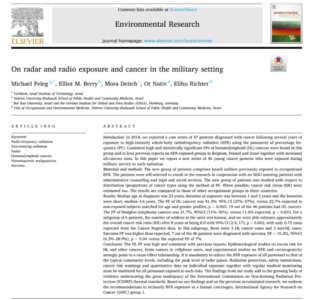
This month (13/1/2026), two studies were published that are intended to be replication/follow-up studies of the well-known NTP study, which found a range of effects of radiation on rats and mice. Among the NTP findings were that radiofrequency radiation from mobile phones led to an increase in cancer cases, oxidative stress, and DNA breaks, as well as lower offspring weight in rodents in the exposed group. The NTP study was published in 2018. The replication studies are referred to as “NTP LITE.”
The replication studies—one Japanese and the other Korean—were both conducted with funding from government ministries (communications and economy).
The headline conclusion of the studies’ summaries was that they failed to replicate the NTP findings. In the abstracts, statements are presented that create the impression that the studies were exact replications of the NTP study and that no findings of effects, illness, or damage related to radiation were observed. However, a more thorough reading of the full articles themselves (see links below) reveals a more complex and far less unequivocal picture. Such a reading shows that the studies are not exact replications of the NTP, that their statistical power is weaker, and that findings were in fact observed, but in most cases they were labeled as “not statistically significant” or “not related to radiation.”
Abstracts
Korea – https://academic.oup.com/toxsci/advance-article/doi/10.1093/toxsci/kfag001/8428133
Japan – https://academic.oup.com/toxsci/advance-article/doi/10.1093/toxsci/kfag002/8423504
Full studies
Korea – https://watermark02.silverchair.com/kfag001.pdf
Japan – https://watermark02.silverchair.com/kfag002.pdf
Critisesm
https://microwavenews.com/short-takes-archive/ntp-lite-korea
https://microwavenews.com/short-takes-archive/ntp-lite-no-cancer-risk-seen-japan
Design to fail
Back when the “replication study” protocols were published in the past, researchers argued that the replication studies (both the Japanese and the Korean ones) were designed from the outset so that the likelihood of detecting a risk would be lower. A variety of differences, which may appear marginal or minor to those unfamiliar with the field, appeared in the protocols when the studies were being planned and launched. Now, with the publication of the studies, these differences are clear, and it is evident that they could have a decisive impact on the results. I increasingly believe that the studies were designed to fail.
The differences can also be explained in a more innocent way—not as ones intended to weaken the studies, but as stemming from the researchers’ assumption that if radiation has an effect on the health of rodents, it would be large and decisive. However, over all the years of research on this topic, the picture that emerges is of a cumulative effect, but not a decisive one. In other words, the radiation is not dangerous, but it is unhealthy.
Let me give an example. If the radiation were dangerous, we would see in the exposed group something like a 20% mortality rate from certain specific cancers—that is, out of 70 rodents, 14 would suffer from a particular disease, or in the NTP study we would have seen 18 sick animals. The replication studies were designed to detect such large increases. But if the radiation is “unhealthy” rather than outright dangerous, we would expect to see an increase of only a few percent across a range of cancers. The NTP study showed exactly this type of pattern: a modest increase across various cancers and biological markers—not on the order of 20%, but rather a few individual cases of disease out of 90 animals in the exposed group. When you are looking for a 20% effect, a relatively small number of animals per group is sufficient. When you expect a “softer” effect, you need to greatly increase the number of animals—possibly even more than in the NTP study—in order to obtain results that do not obscure the real situation.
Far fewer rodents
The first obvious difference between the NTP study and the replication studies is the number of rodents in the exposure groups and the number of exposure groups themselves. In the NTP study there were many more rodents in each group and many more groups exposed to radiation. The NTP study is larger and more robust.
For example, the number of rodents exposed to radiation in the NTP study (1,080 in the main study) is significantly higher than the number exposed in the “replication studies” (only 140 in each study).
Less radiation exposure
Another difference that immediately stands out is that in the NTP study there were three different exposure levels: 1.5 W/kg, 3 W/kg, and 6 W/kg. In the replication studies, exposure was only at 4 W/kg. This means it will not be possible to observe a dose–response relationship; in addition, the overall exposure is lower, and in practice there are far fewer groups of rodents exposed to radiation.
Only CDMA was tested, not GSM
In addition, exposure in the “replication studies” was to radiation using the CDMA transmission method. In the NTP study, exposure was to both CDMA and GSM. For those unfamiliar with second-generation mobile transmission methods: in GSM, the peak power levels (the transmission spikes) are much higher and occur more frequently per second than in CDMA. The most significant findings were דווקא in the GSM exposure groups, not in CDMA. So what exactly are they trying to replicate? The part of the NTP study that showed fewer findings?
The researchers themselves admit: “the studies are significantly weaker.”
That is, the replication studies—both the Japanese and the Korean ones—do not truly replicate the NTP study, and if they resemble it at all, they resemble the part of the NTP that found fewer effects… well, so be it.
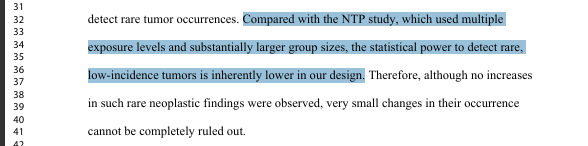
The changes in exposure levels, the number of exposure groups, the total number of rodents exposed to radiation, the absence of GSM exposure, and more, make the replication studies very weak statistically—especially when searching for relatively rare cancers. Even the authors of the study say this themselves, on page 24, line 32 of the Japanese study.
Differences between the NTP and the NTP-LITE studies
| NTP | NTP-Lite – JAPAN | NTP-Lite – KOREA | |
| exposure type | GSM, CDMA 900MHZ, 1900MHZ | CDMA 900MHZ | CDMA 900MHZ |
| Rodents type | Rates and Mice, males and females. | Rates males and females. | Rates males and females. |
| Number of Rodents | 2160 | 68+70+70 =208 | 66+70+70 = 206 |
| Number of rodents in each group | 90 | 70 | 70 |
| Number of exposure groups | 12 | 1 | 1 |
| Number of Control groups | 4 | 2 | 2 |
| Groups | Control Group, 1.5W/Kg Group. 3 W/Kg Group, 6 W/Kg Group | Control group, RF exposure cage 0 W/Kg Group, RF exposure cage 4 W/Kg Group, | Control group, RF exposure cage 0 W/Kg Group, RF exposure cage 4 W/Kg Group, |
Stages
| NTP | NTP-Lite – JAPAN | NTP-Lite – KOREA | |
| Stage 1 | 28-day Toxicity study – Making sure the exposure does not kill the rodents. | Sixty males and 120 females, all 4-week-old pups. An acclimation period of 8 weeks, with mating at approximately 12 weeks of age. Twenty pregnant females were assigned to the exposure groups. Exposure began on the fifth day of pregnancy and continued until 28 days after weaning of the male offspring. In total, 66 days of exposure. Blood samples were taken, as well as measurements of body weight, organ weights, food consumption, and additional clinical parameters. | Sixty males and 120 females, all 4-week-old pups. An acclimation period of 8 weeks, with mating at approximately 12 weeks of age. Twenty pregnant females were assigned to the exposure groups. Exposure began on the fifth day of pregnancy and continued until 28 days after weaning of the male offspring. In total, 66 days of exposure. Blood samples were taken, as well as measurements of body weight, organ weights, food consumption, and additional clinical parameters. |
| Stage 2 | Fourteen weeks (98 days); 140 males and 140 females, starting at 8 weeks of age, with an acclimation period of 4–5 days, followed by mating at 12–15 weeks. Approximately 90 pregnancies were recorded, of which 60 were assigned to the control groups and 30 to the exposure group. At the end of the exposure period (a total of about 14 weeks), the rodents were sacrificed and examined for genetic damage, mutations, and other effects. | Fourteen weeks (98 days); 140 males and 140 females, starting at 8 weeks of age, with an acclimation period of 4–5 days, followed by mating at 12–15 weeks. Approximately 90 pregnancies were recorded, of which 60 were assigned to the control group and 30 to the exposure group. At the end of the exposure period (a total of about 14 weeks), the rodents were sacrificed and examined for genetic damage, mutations, and other effects. | |
| Stage 3 | 90 weeks study | 104 weeks (728 days). Exposure began after weaning. The number of deaths, body weight, food consumption, general health, organ health, and tumors in various organs (brain, heart, adrenal gland), among other parameters, were examined. | 104 weeks (728 days). Exposure began after weaning. The number of deaths, body weight, food consumption, general health, organ health, and tumors in various organs (brain, heart, adrenal gland), among other parameters, were examined. |