
This page was created with the help of AI
Preview
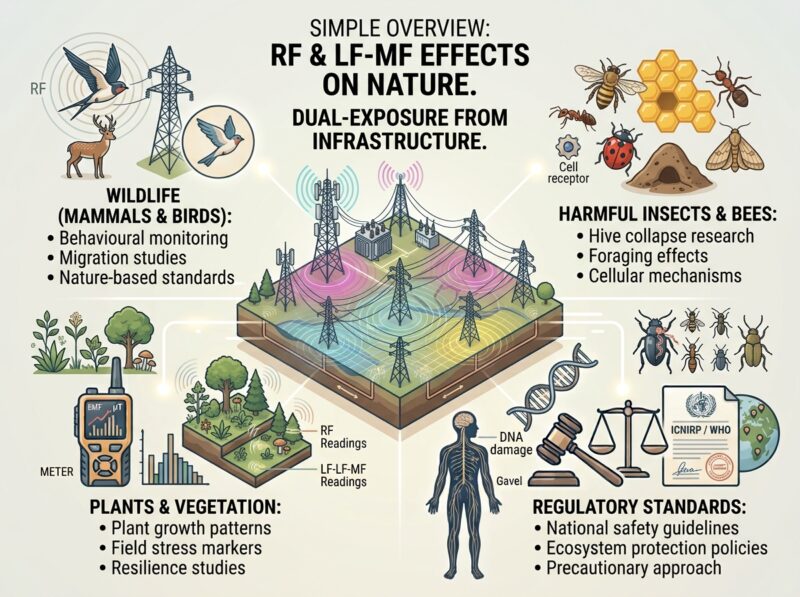
Over the past decade, a growing number of studies have examined the effects of man-made electromagnetic radiation on nature. The most comprehensive series of reviews in the field was published in 2021 by Levitt, Lai and Manville, in 3 parts: rising radiation levels in the environment, the effects on animals and plants, and the need to update standards and policy. The same researchers published updates in 2022 and 2025.
On plants, Halgamuge’s review (2017) found that about 90% of the experiments examined reported changes in plants exposed to mobile phone radiation. Waldmann-Selsam et al. (2016) documented damage to trees on the side facing mobile phone antennas. Three studies examined on duckweed, a plant often used for environmental monitoring. Tkalec et al. (2005, 2007) found that radio frequency radiation reduces plant growth and causes oxidative stress, and that the effect depends on frequency, field strength, and exposure time. Ben-Izhak Monselise et al. (2011) found signs of stress in the plant’s cells near AM radio transmitting antennas, at a strength that matched the level of exposure.
On animals, Balmori (2021) proposed radiation as one of the possible factors in the decline of insect populations. The meta-analysis by Thill, Cammaerts and Balmori (2023) found biological effects on insects. Engels et al. (2014), in a study published in Nature, showed that weak urban electromagnetic noise disrupts the magnetic orientation of migratory birds. Henshaw and Philips (2024) reviewed the literature on magnetoreception in animals and argue that radiation affects them even at levels below the standards.
Honeybees are especially important for pollination, so the effect of electromagnetic fields and radio frequency radiation on them has also been studied. Favre (2011), Odemer and Odemer (2019), and Treder et al. (2023) found effects of man-made radio frequency radiation on honeybees, and a meta-analysis by Thill, Cammaerts, and Balmori (2023) found biological effects of electromagnetic fields on insects, including honeybees. Shepherd et al. (2018) and Molina-Montenegro et al. (2023) found effects of low-frequency magnetic fields on honeybees.
Henshaw and Philips (2024) argue, based on the literature on magnetoreception in animals, that non-ionizing radiation affects animals even at levels below the standards.
Hässig et al. (2009, 2014) found a possible link between mobile phone antennas and cataracts in calves, but no proof of causation. The Bavarian cattle studies found changes in behavior and higher levels of the stress hormone cortisol in cows exposed to antennas. Hutchison et al. (2020) found that the fields from a subsea power cable change the exploratory behavior of cartilaginous fish and lobsters.
Bormusov et al., Israel and USA, 2008 found Non-Thermal Electromagnetic Radiation Damage to Lens Epithelium.
Partial list of studies with a focus on the effect of man-made EMF/EMR (mainly RF) on wildlife, trees, insects, and the environment.
- Levitt, Lai and Manville, USA, 2021 – Effects of Non-Ionizing Electromagnetic Fields on Flora and Fauna, Part 1 – Rising Ambient EMF Levels in the Environment
https://pubmed.ncbi.nlm.nih.gov/34047144/
DOI: 10.1515/reveh-2021-0026
– A comprehensive review of the rise in environmental radiation levels and of the exposure of animals and plants. - Levitt, Lai and Manville, USA, 2021 – Effects of Non-Ionizing Electromagnetic Fields on Flora and Fauna, Part 2 – How Species Interact with Natural and Man-Made EMF
https://pubmed.ncbi.nlm.nih.gov/34243228/
DOI: 10.1515/reveh-2021-0050
– A review of effects on birds, insects, bees, amphibians, plants and more. - Levitt, Lai and Manville, USA, 2021 – Effects of Non-Ionizing Electromagnetic Fields on Flora and Fauna, Part 3 – Exposure Standards, Public Policy, Laws and Future Directions
https://pubmed.ncbi.nlm.nih.gov/34563106/
DOI: 10.1515/reveh-2021-0083
– The authors argue that exposure standards do not take animals and plants into account, and recommend policy changes. - Levitt, Lai and Manville, 2022 – Low-Level EMF Effects on Wildlife and Plants – An Ecosystem Approach
https://www.frontiersin.org/articles/10.3389/fpubh.2022.1000840
DOI: 10.3389/fpubh.2022.1000840
– A summary of the scientific evidence and a call to examine the effects at the ecosystem level. - Levitt, Lai and Manville, 2025 – Flora and Fauna – How Nonhuman Species Interact with Natural and Man-Made EMF at Ecosystem Levels, and Public Policy Recommendations
https://www.frontiersin.org/articles/10.3389/fpubh.2025.1693873
DOI: 10.3389/fpubh.2025.1693873
– An update of the earlier reviews. A correction has also been published (DOI: 10.3389/fpubh.2026.1796521). - Malka Halgamuge, Australia, 2017 – Review: Weak Radiofrequency Radiation Exposure from Mobile Phone Radiation on Plants
https://pubmed.ncbi.nlm.nih.gov/27650031/
DOI: 10.1080/15368378.2016.1220389
– A review of 45 studies and 169 experiments on 29 plant species. About 90% reported physiological or morphological changes. - Waldmann-Selsam et al., Germany and Spain, 2016 – Radiofrequency Radiation Injures Trees Around Mobile Phone Base Stations
http://www.sciencedirect.com/science/article/pii/S0048969716317375
– Documentation of damage to trees on the side facing mobile phone antennas, compared with the side shielded from them. - Tkalec et al., Croatia, 2005 – Influence of 400, 900 and 1900 MHz Electromagnetic Fields on Duckweed Growth and Peroxidase Activity
Bioelectromagnetics 26(3): 185–193
https://pubmed.ncbi.nlm.nih.gov/15768427/
DOI: 10.1002/bem.20104
– A 2-hour exposure to a 900 MHz field (23 V/m) significantly reduced plant growth, and a modulated field reduced it even more. A longer exposure at low strength (10 V/m for 14 hours) reduced growth at 400 and 1900 MHz. The effects depended strongly on frequency, field strength and exposure time. - Tkalec et al., Croatia, 2007 – Exposure to Radiofrequency Radiation Induces Oxidative Stress in Duckweed
Science of the Total Environment 388: 78–89
https://pubmed.ncbi.nlm.nih.gov/17825879/
DOI: 10.1016/j.scitotenv.2007.07.052
– A 2-hour exposure to 400 and 900 MHz fields caused oxidative stress in the plant: increased lipid peroxidation and hydrogen peroxide levels, and changes in the activity of antioxidant enzymes. The effect was especially marked at 900 MHz. The researchers stress that the exposure was non-thermal. - Ben-Izhak Monselise et al., Israel, 2011 – Bioassay for Assessing Cell Stress in the Vicinity of Radio-Frequency Irradiating Antennas
Journal of Environmental Monitoring 13(7): 1890–1896
https://pubmed.ncbi.nlm.nih.gov/21655615/
DOI: 10.1039/c1em10031a
– Duckweed was exposed for 24 hours to radiation from 1.287 MHz AM radio transmitting antennas, at field strengths of 1.8 to 7.8 V/m. The exposure caused the cells to accumulate the amino acid alanine, a general stress marker, and the size of the effect matched the level of exposure. In the presence of vitamin C the effect disappeared, suggesting the involvement of free radicals. - Balmori, Spain, 2021 – Electromagnetic Radiation as an Emerging Driver Factor for the Decline of Insects
https://pubmed.ncbi.nlm.nih.gov/33636787/
DOI: 10.1016/j.scitotenv.2020.144913
– The article proposes electromagnetic radiation as one of the possible factors in the decline of insect populations, alongside other factors. - Thill, Cammaerts and Balmori, 2023 – Biological Effects of Electromagnetic Fields on Insects – A Systematic Review and Meta-Analysis
https://pubmed.ncbi.nlm.nih.gov/37990587/
DOI: 10.1515/reveh-2023-0072
– A meta-analysis of studies on insects that found biological effects of exposure to electromagnetic fields. - Engels et al., Germany, 2014 – Anthropogenic Electromagnetic Noise Disrupts Magnetic Compass Orientation in a Migratory Bird
https://www.nature.com/articles/nature13290
DOI: 10.1038/nature13290
– An experiment published in Nature: European robins lost their magnetic orientation in weak urban electromagnetic noise, and regained it when shielded from it. - Cucurachi et al., Netherlands, 2013 – A Review of the Ecological Effects of Radiofrequency Electromagnetic Fields
https://www.rivm.nl/publicaties/a-review-of-ecological-effects-of-radiofrequency-electromagnetic-fields-rf-emf
Environment International 51 (2013): 116–140
– A review of 113 studies that found reported effects in animals and plants. The authors also note many methodological weaknesses in the studies, and call for higher-quality research, especially in the field. - Favre, Switzerland, 2011 – Mobile Phones Induced Honeybee Workers to Emit a “Piping” Signal
Mobile phone-induced honeybee worker piping, Apidologie 42(3): 270–279
https://doc.rero.ch/record/318195
– Hives were exposed to 900 MHz mobile phones. In talk mode, about 25 to 40 minutes after the call began, the workers emitted a “piping” signal. This signal usually appears before swarming or when the colony is disturbed. The study has also been criticized, among other things for the small number of hives. - Odemer and Odemer, Germany, 2019 – The Effect of Radio Frequency Radiation on Honeybee Queen Development and Mating Success
Science of the Total Environment 661 (2019): 553–562
https://emf-portal.org/en/article/37196
– Queen larvae were exposed to GSM radiation throughout their development, including the pupal stage. The exposure reduced the number of queens that hatched. However, no effect was found on mating success, and the colonies of queens that mated developed normally. - Shepherd et al., UK, 2018 – Extremely Low Frequency Electromagnetic Fields Impair the Cognitive and Motor Abilities of Honeybees
Scientific Reports, 2018
https://pmc.ncbi.nlm.nih.gov/articles/PMC5962564/
– A study on low-frequency fields, such as those from power lines, not on radio frequency radiation. The researchers found impaired learning, memory, and movement in honeybees. - Molina-Montenegro et al., Chile, 2023 – Electromagnetic Fields Disrupt the Pollination Service by Honeybees
Science Advances, 2023
https://www.science.org/doi/10.1126/sciadv.adh1455
DOI: 10.1126/sciadv.adh1455
– This study also concerns power-frequency fields from overhead power lines. The bees avoided flowers near the lines, and plant populations in those areas were less diverse and less abundant. - Treder et al., Germany, 2023 – Controlled Exposure of Honeybee Colonies to Simulated Radio Frequency Radiation: Impaired Homing Ability, but No Effect on Brood Development or Longevity
Science of the Total Environment 896 (2023): 165211
https://www.sciencedirect.com/science/article/pii/S0048969723038342
– The bees’ ability to return to the hive was impaired. However, no effect was found on brood development or longevity. - Thill, Cammaerts and Balmori, 2023 – Biological Effects of Electromagnetic Fields on Insects – A Systematic Review and Meta-Analysis
https://pubmed.ncbi.nlm.nih.gov/37990587/
DOI: 10.1515/reveh-2023-0072
– A review of insects in general that also includes studies on honeybees. - Henshaw and Philips, UK, 2024 – A Mechanistic Understanding of Human Magnetoreception Validates the Phenomenon of Electromagnetic Hypersensitivity (EHS)
https://www.tandfonline.com/doi/full/10.1080/09553002.2024.2435329
International Journal of Radiation Biology 101(2): 186–204
DOI: 10.1080/09553002.2024.2435329
– The article draws on the extensive literature on magnetoreception in animals and argues that non-ionizing radiation affects animals at levels low relative to existing standards. - Hässig et al., Switzerland, 2009 – Prevalence of Nuclear Cataract in Swiss Calves and Its Possible Association with Mobile Phone Antennas
Schweizer Archiv für Tierheilkunde 151(10): 471–478
https://emf-portal.org/en/article/17570
– 253 calves were examined, and 32% of them had nuclear cataract of varying degrees. A link was found between the mother’s location during the first trimester of pregnancy and antenna strength, and between oxidative stress and distance from the nearest antenna. The researchers stress that it was not proven that the antennas are the cause, and call for further research. - Hässig et al., Switzerland, 2014 – Increased Occurrence of Cataract in Calves After the Erection of a Mobile Phone Antenna
BMC Veterinary Research 10:136
https://emf-portal.org/en/article/20179
– A case study on a single farm located near a GSM antenna. According to the farmer’s records, cataract increased about a year after the antenna was erected and decreased after it was removed. The researchers found a correlation in time, but no proof of causation. - Hutchison et al., USA, 2020 – Anthropogenic Electromagnetic Fields Influence the Behavior of Bottom-Dwelling Marine Species
Scientific Reports 10: 4219
https://doi.org/10.1038/s41598-020-60793-x
DOI: 10.1038/s41598-020-60793-x
– The study examined the effect of a subsea power cable on the little skate (a cartilaginous fish) and the American lobster. The skate showed a marked increase in exploratory and foraging behavior, and the lobster a more subtle effect. These are fields from a power cable, not mobile phone radiation. - Bormusov et al., Israel and USA, 2008 – Non-Thermal Electromagnetic Radiation Damage to Lens Epithelium
Open Ophthalmology Journal 2: 102–106
https://pmc.ncbi.nlm.nih.gov/articles/PMC2694600/
DOI: 10.2174/1874364100802010102
– Calf eye lenses in laboratory culture were exposed to low-power (2.22 mW) 1.1 GHz microwave radiation. The exposure caused a reversible decrease in the lens’s optical quality and irreversible damage to its epithelial cell layer. The damage was clearly different from that caused by heat, so the researchers concluded it was a non-thermal effect.